News article
Our First 10,000 Pages Processed!
Published on
By OnPaper Team
OnPaper has crossed the 10,000-page milestone. Here is what we learned about accuracy, speed, and what our customers are automating.
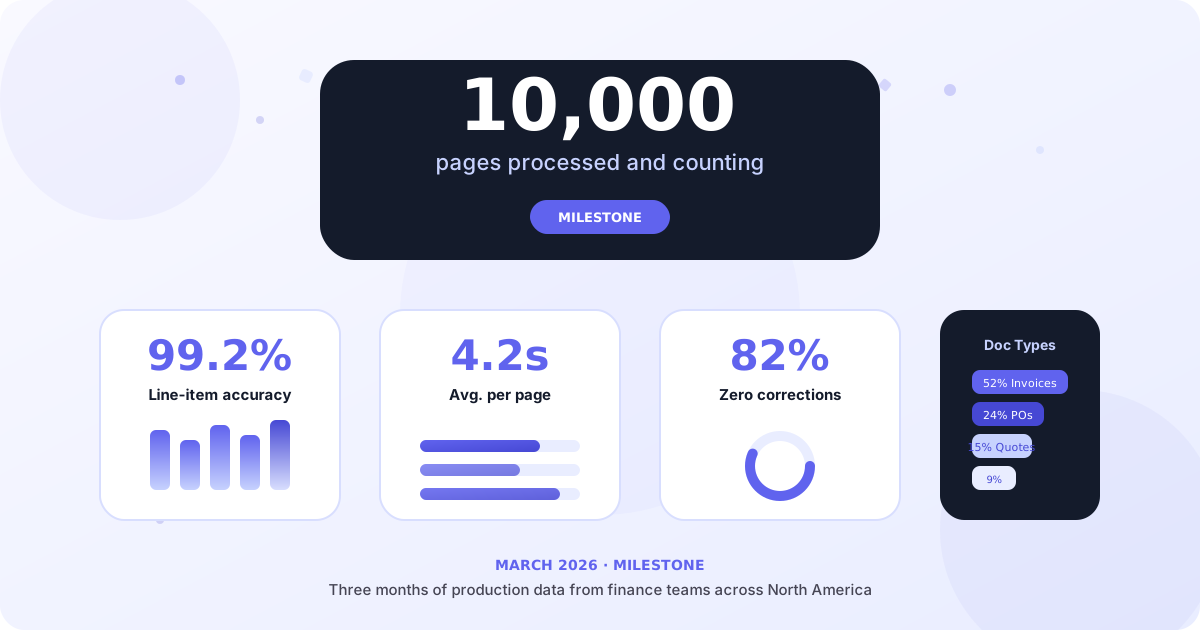
10,000 pages and counting
Three months after launch, OnPaper has processed over 10,000 pages of invoices, purchase orders, quotes, and expense reports for finance teams across North America. This is a milestone we are proud of — and one that taught us a lot about what real-world document automation looks like.
The numbers
Here is what 10,000 pages of production data tells us:
- 99.2% line-item accuracy — Across all document types, our multi-engine OCR fusion consistently delivers on the accuracy promise. The remaining 0.8% gets caught by our validation layer before anything reaches an ERP.
- Average processing time: 4.2 seconds per page — From PDF upload to structured, validated output ready for review. That includes OCR extraction, cross-engine fusion, field validation, and schema mapping.
- 82% of pages required zero human corrections — The majority of documents flow straight through to ERP sync after a quick review confirmation. No edits, no rekeying.
What our customers are processing
The breakdown of the first 10,000 pages surprised us:
- Invoices — 52% of all pages. No surprise here. AP automation is the primary use case, and invoices are the document finance teams hate keying the most.
- Purchase orders — 24% of pages. Procurement teams are using OnPaper to match POs against incoming invoices automatically.
- Quotes and estimates — 15% of pages. Sales operations teams are extracting line items from vendor quotes to speed up comparison workflows.
- Expense reports and receipts — 9% of pages. Smaller volume but high impact — employees submit receipt photos and OnPaper extracts amounts, dates, and categories.
What we learned
Processing real documents at scale taught us things no amount of testing could:
- Document quality varies wildly — Some customers upload crisp digital PDFs. Others send photos of crumpled receipts taken in poor lighting. Our multi-engine approach handles both, but we invested heavily in pre-processing normalization to handle the worst cases.
- Every ERP has quirks — Field naming conventions, date formats, tax code structures — no two ERP setups are identical, even on the same platform. We built a flexible mapping layer that adapts to each customer’s configuration.
- Speed matters more than we expected — Finance teams process documents in batches, often under deadline pressure. Shaving seconds off per-page processing time has an outsized impact on daily workflow.
What comes next
Ten thousand pages is just the start. We are now focused on:
- Expanding document type support — Contracts, delivery notes, and bank statements are on the roadmap.
- Self-improving accuracy — Every correction a reviewer makes feeds back into our extraction models. The system gets smarter with every page.
- Deeper ERP workflows — Beyond posting data, we are building automated matching, approval routing, and exception handling directly in the platform.
Thank you to every team that trusted OnPaper with their documents. The next 10,000 pages will be even better. Get started with OnPaper.